Miscellaneous items are any products or services in Elecate that are not food, beverage, or equipment — such as floral arrangements, valet parking, coat check, concierge services, staffing packages, gratuities, delivery fees, or any other add-on charge.
How to access Miscellaneous Item Management
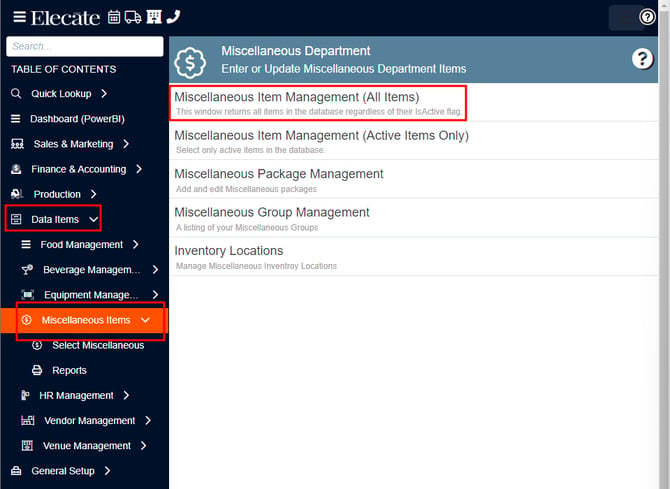
- On the left side panel, click Data Items.
- Click Miscellaneous Items.
- Click Miscellaneous Item Management (All Items).
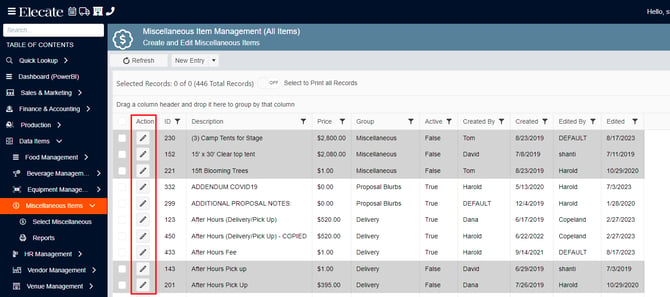
4. The list of all miscellaneous items opens. Click New Entry.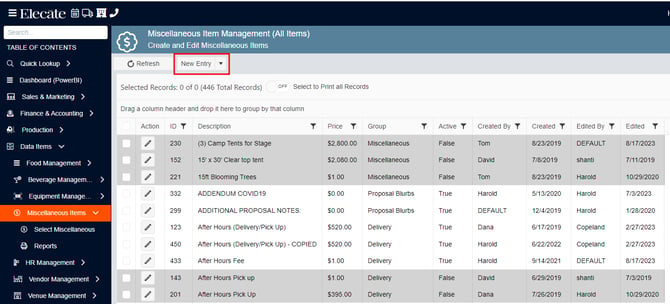
To edit an existing item
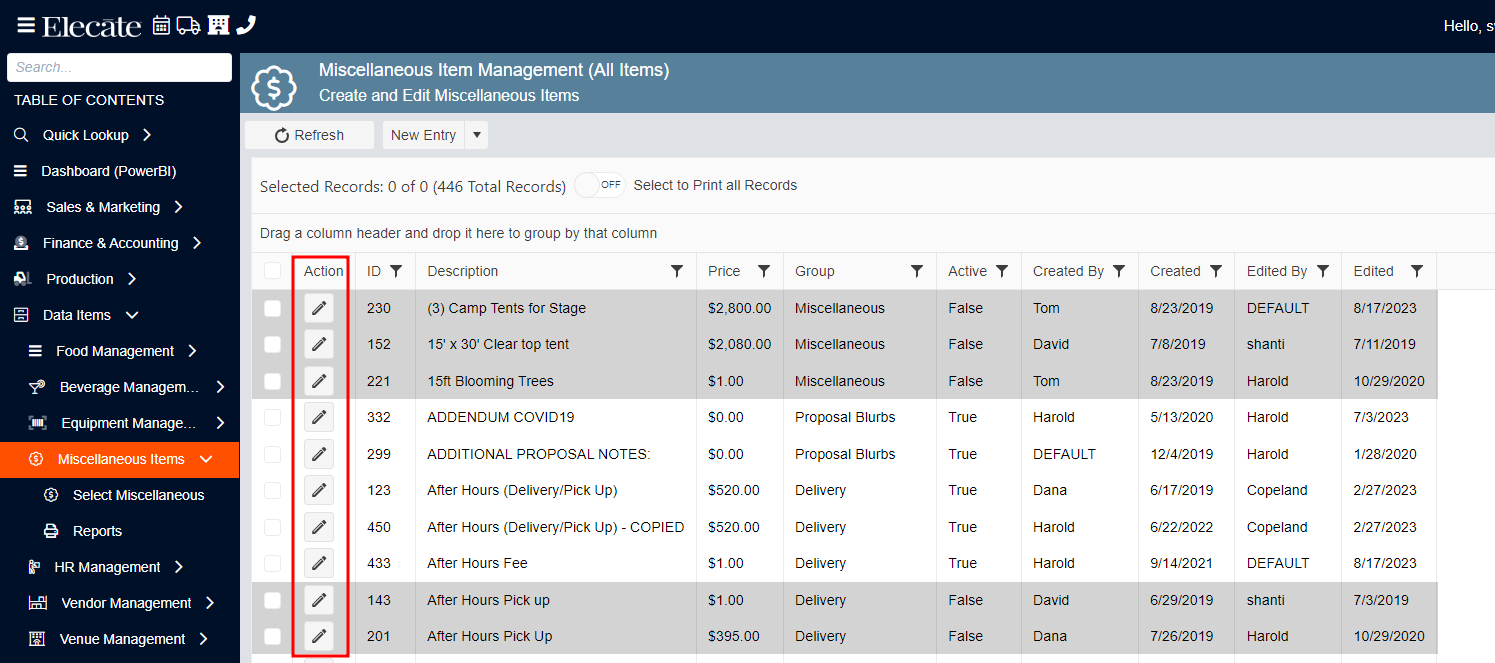
Click the pencil icon in the Action column of the item you want to edit.
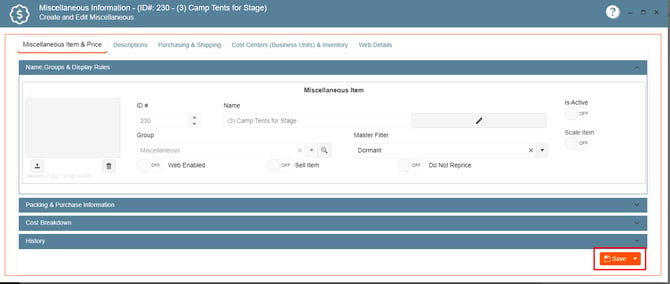
The Miscellaneous Information window opens. It has 5 tabs:
| Tab | Purpose |
|---|---|
| Miscellaneous Item & Price | Name, groups, display settings, units, and pricing |
| Descriptions | Client-facing descriptions and internal notes |
| Purchasing & Shipping | Vendor, delivery rules, and purchase preferences |
| Cost Centers (Business Units) & Inventory | Assign to cost centers and track inventory |
| Web Details | Web portal and POS settings |
Every tab includes a History section at the bottom (Created By, Created Date, Edited By, Edited Date) — read-only audit trail.
Tab 1: Miscellaneous Item & Price
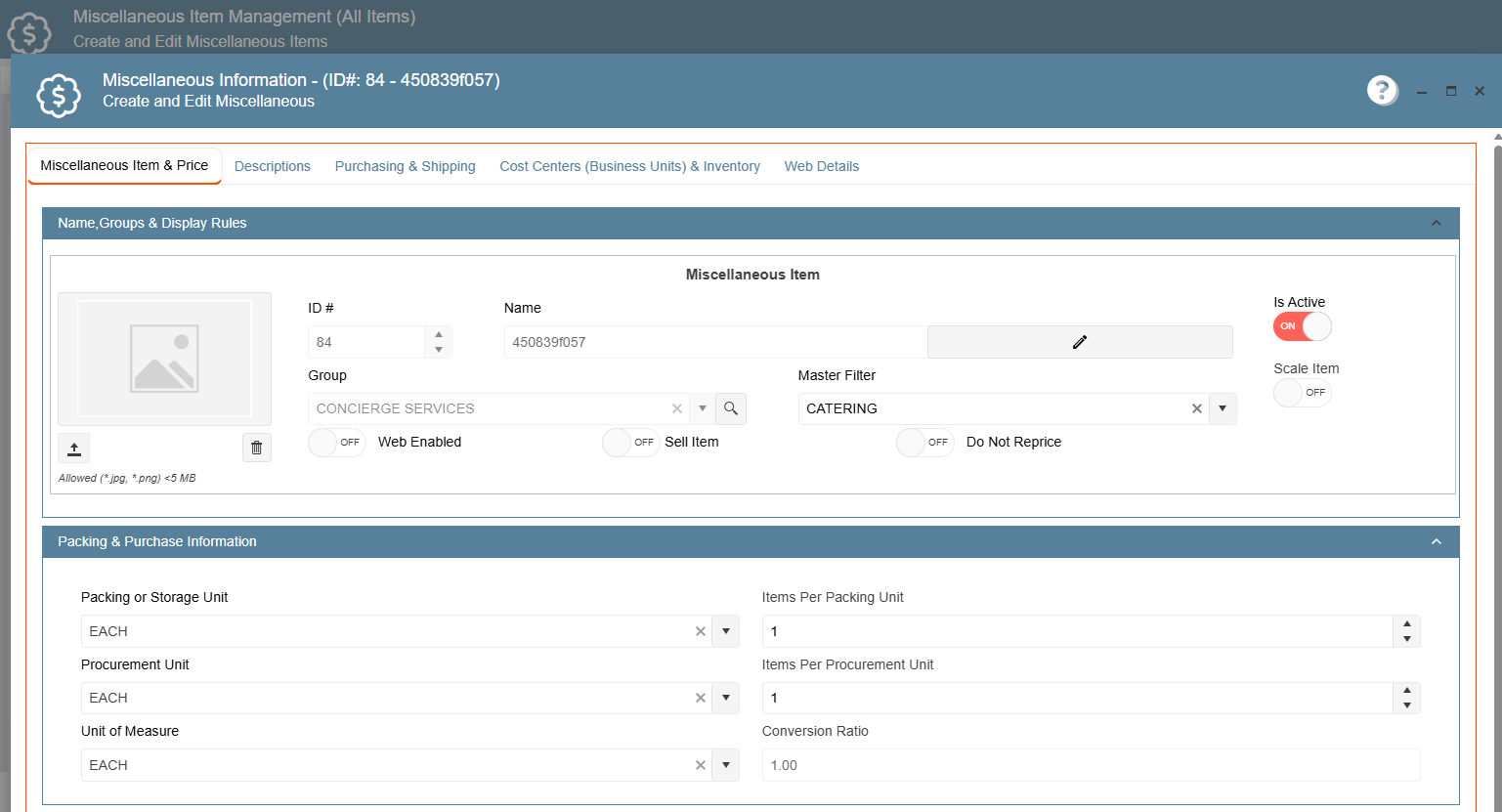
This tab is divided into three sections.
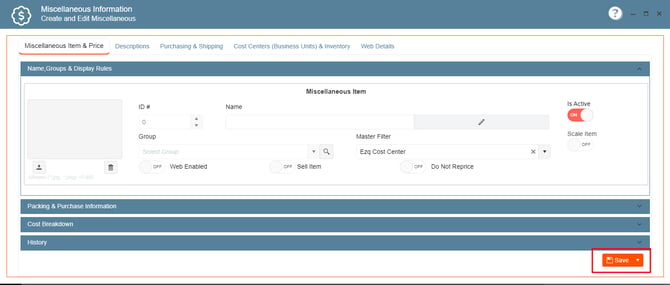
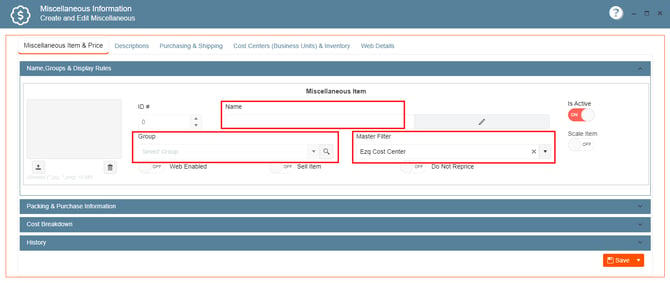
Name, Groups & Display Rules — Miscellaneous Item
| Field | Description |
|---|---|
| Photo | Item image. Upload .jpg or .png, max 5 MB. Displays on proposals and web portal. |
| ID # | Auto-generated system identifier. Read-only. |
| Name | The item name as it appears in event orders, proposals, and reports (e.g., "Valet Parking", "Coat Check", "Delivery Fee"). Click the pencil icon to edit. |
| Is Active | Toggle ON to make the item available for selection. Toggle OFF to retire it without deleting. Default: ON. |
| Group | Assigns the item to an organizational group for filtering and reporting. Use the search icon to look up groups or the document icon to create a new one. Example: CONCIERGE SERVICES. |
| Master Filter | The business unit or cost center this item belongs to. Controls visibility across divisions. Example: CATERING. |
| Scale Item | Toggle ON if the item price scales proportionally (e.g., by guest count or quantity). Default: OFF. |
| Web Enabled | Toggle ON to make this item available on the Elecate web portal or online ordering. Default: OFF. |
| Sell Item | Toggle ON if this item is sold directly to the client as a standalone charge. Toggle OFF for items that are internal costs or pass-through charges. Default: OFF. |
| Do Not Reprice | Toggle ON to lock this item's price during system-wide repricing operations — the price will not change when batch repricing is run. Default: OFF. |
Section: Packing & Purchase Information — Purchasing/Usage Breakdowns
| Field | Description |
|---|---|
| Packing or Storage Unit | The unit used to store or package this item (e.g., EACH). Configured in General Setup → Recipe → Purchasing Units. |
| Items Per Packing Unit | How many individual units are in one packing unit. Default: 1. |
| Procurement Unit | The unit used when purchasing from a vendor (e.g., EACH, CASE). |
| Items Per Procurement Unit | How many individual units come in one procurement purchase. Default: 1. |
| Unit of Measure | The base unit used for event ordering and tracking (e.g., EACH). |
| Conversion Ratio | The numeric relationship between the Procurement Unit and the Unit of Measure. Default: 1.00. |
Section: Cost Breakdown — Costing Information
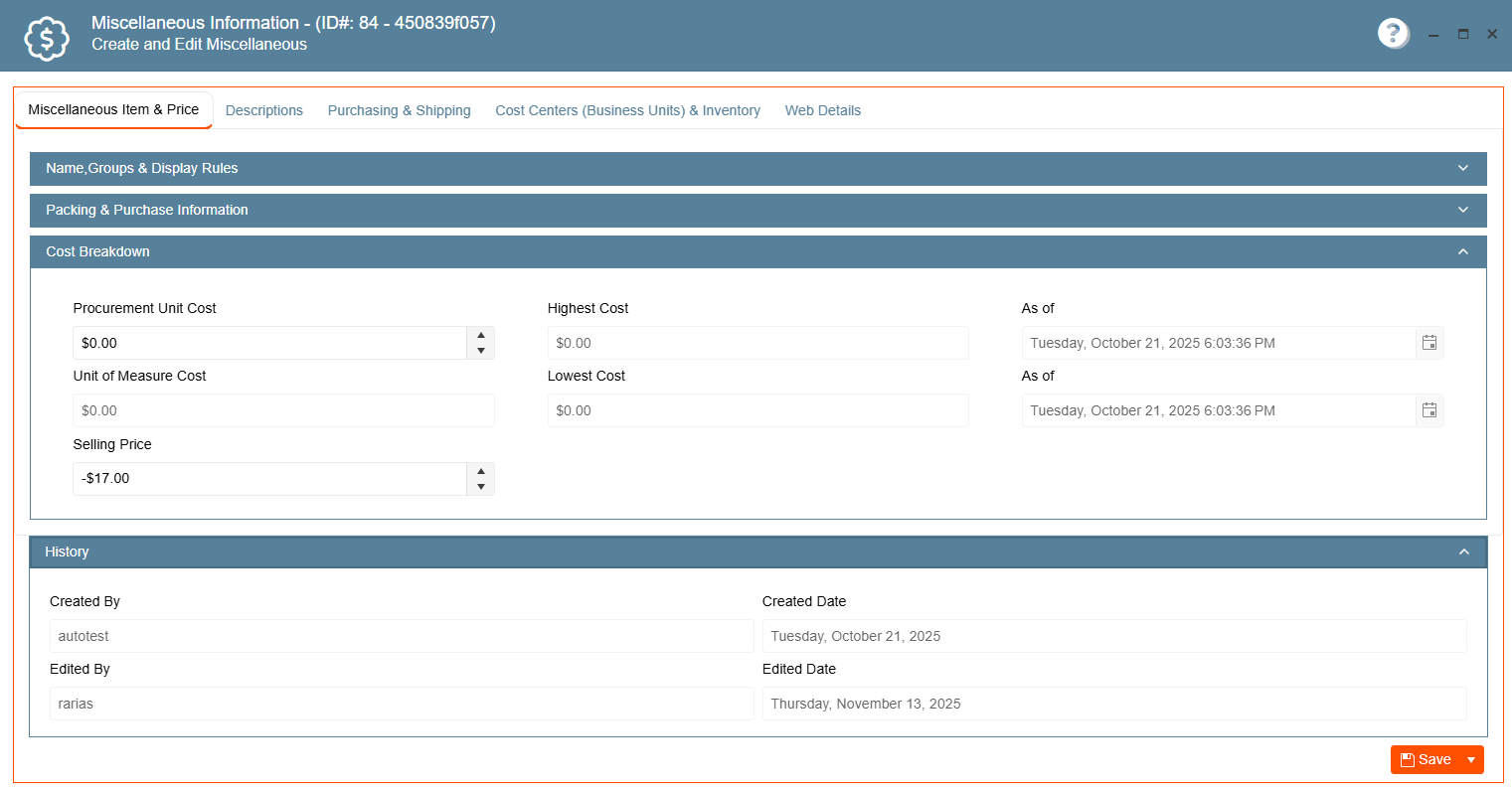
| Field | Description |
|---|---|
| Procurement Unit Cost | The cost paid to the vendor per procurement unit. Enter your actual purchase or internal cost. |
| Unit of Measure Cost | The cost per individual unit of measure, derived from the procurement cost and conversion ratio. |
| Selling Price | The price charged to clients per unit. This is the field that drives event billing. Can be negative for discounts or adjustments (e.g., -$17.00 for a discount item). |
| Highest Cost | Read-only. The highest cost ever recorded for this item. Auto-updated. |
| Lowest Cost | Read-only. The lowest cost ever recorded for this item. Auto-updated. |
| As of (Highest / Lowest) | Read-only. The date when each cost extreme was last recorded. |
Negative Selling Price: Miscellaneous items support negative prices. Use this for discount items, credits, or adjustments that reduce the event total (e.g., an early booking discount entered as a miscellaneous line item).
Tab 2: Descriptions
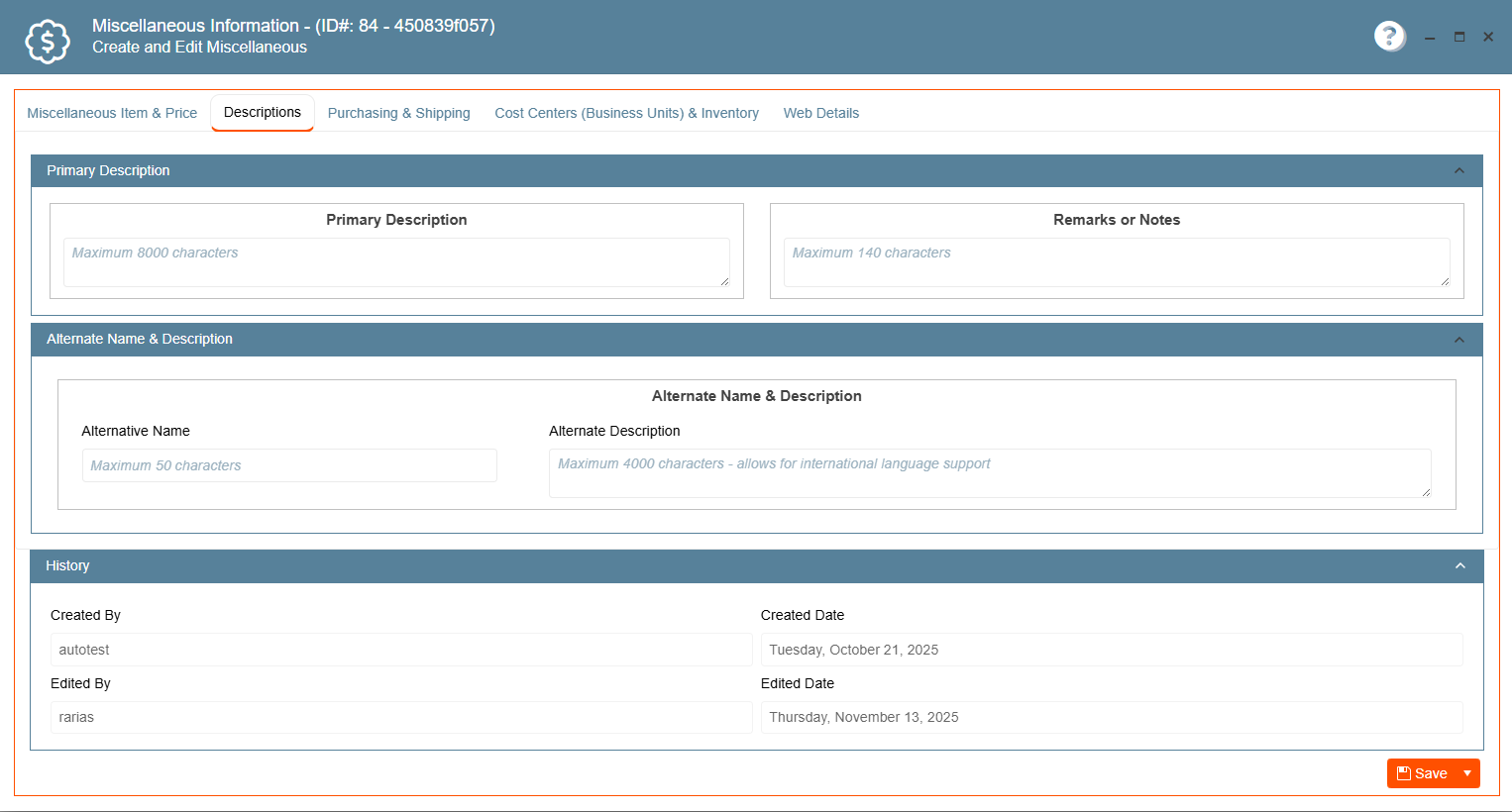
Identical structure to Beverage and Equipment descriptions.
Section: Primary Description
| Field | Limit | Description |
|---|---|---|
| Primary Description | 8,000 characters | Main description of the item. Appears on proposals, menus, and event documents. Write this for the client's perspective. |
| Remarks or Notes | 140 characters | Short internal note. Not typically visible to clients. |
Section: Alternate Name & Description
| Field | Limit | Description |
|---|---|---|
| Alternative Name | 50 characters | An alternate display name — useful for multilingual menus or simplified labels. |
| Alternate Description | 4,000 characters | Alternate description with international language support. Use when your operation serves clients in multiple languages. |
Tab 3 — Purchasing & Shipping
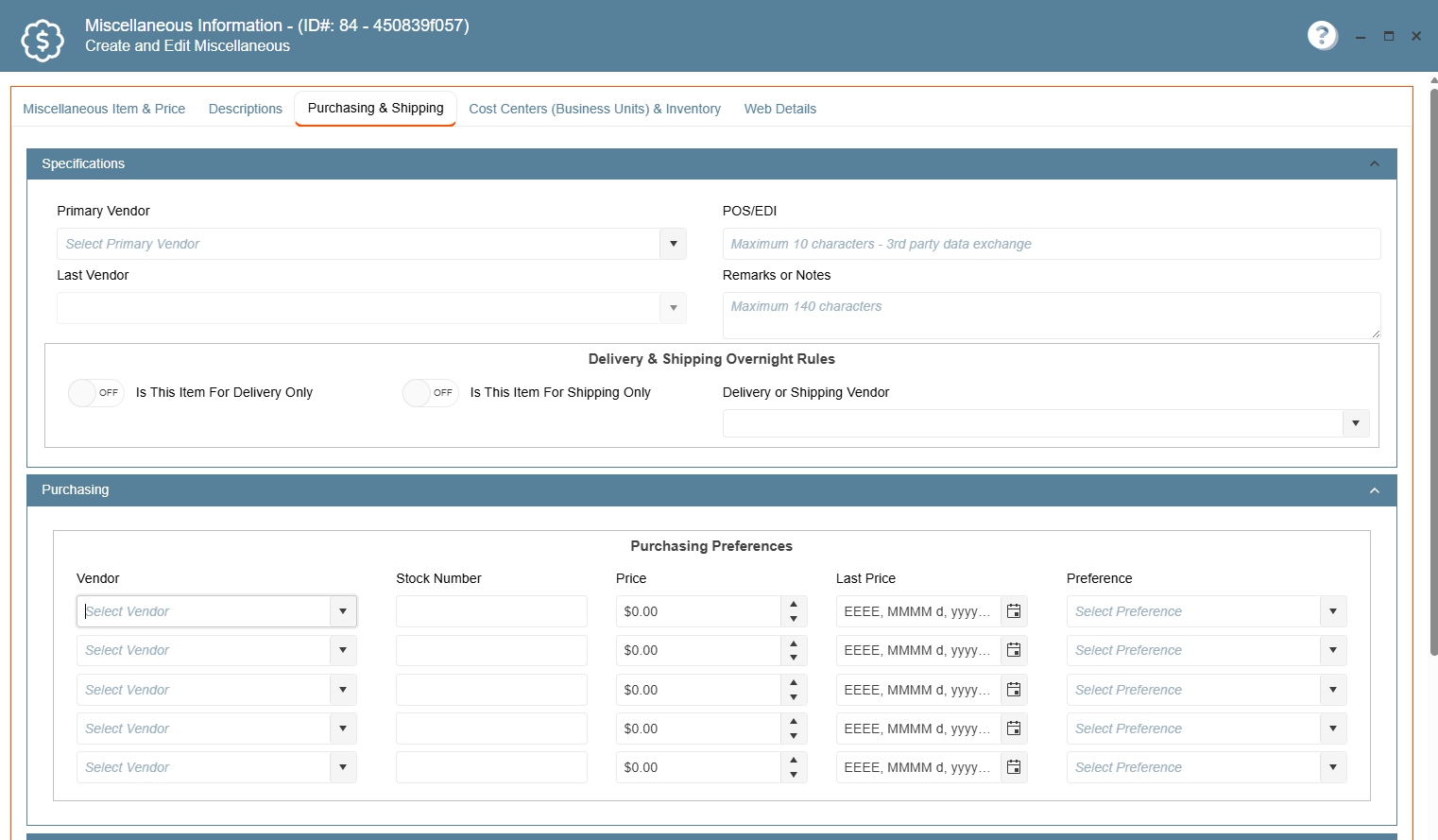
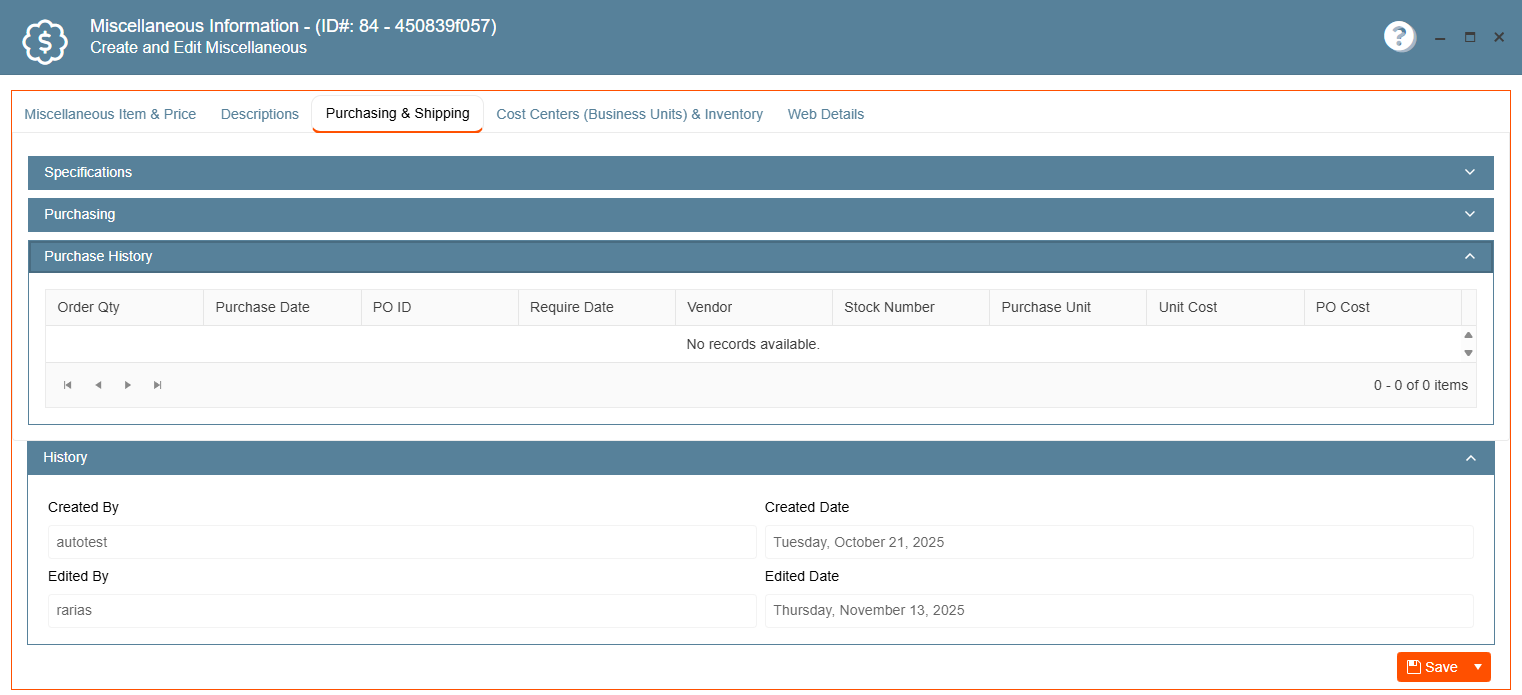
Section: Specifications
| Field | Description |
|---|---|
| Primary Vendor | The main supplier for this item. Select from the vendor list. |
| Last Vendor | Read-only. The most recent vendor used to purchase this item. |
| POS/EDI | Electronic data interchange or POS reference code for third-party system integration. Max 10 characters. |
| Remarks or Notes | Internal purchasing notes (e.g., lead time, minimum order). Max 140 characters. |
Section: Delivery & Shipping Overnight Rules
| Field | Description |
|---|---|
| Is This Item For Delivery Only | Toggle ON if this item is exclusively delivered and cannot be picked up. Affects dispatching module filtering. |
| Is This Item For Shipping Only | Toggle ON if this item is exclusively shipped (e.g., overnight courier) and not delivered by your own fleet. |
| Delivery or Shipping Vendor | The specific vendor used for delivering or shipping this item. |
These rules determine how the item appears in the Dispatching and Shipping modules. An item marked as Delivery Only will not appear in shipping-only workflows, and vice versa.
Section: Purchasing — Purchasing Preferences
Up to 5 alternate vendor options for this item. For each row:
| Field | Description |
|---|---|
| Vendor | Alternate vendor for this item |
| Stock Number | Vendor's item reference number |
| Price | Price from this vendor |
| Last Price | Most recent price paid to this vendor |
| Preference | Priority order when multiple vendors are available |
Section: Purchase History (read-only)
Grid showing all past purchase orders for this item:
| Column | Description |
|---|---|
| Order Qty | Quantity ordered |
| Purchase Date | Date the purchase order was created |
| PO ID | Purchase Order identifier |
| Require Date | Date the item is needed |
| Vendor | Supplier used for that order |
| Stock Number | Vendor's item reference number |
| Purchase Unit | Unit used in the purchase |
| Unit Cost | Cost per unit on that order |
| PO Cost | Total cost of that purchase order |
Tab 4 — Cost Centers (Business Units) & Inventory
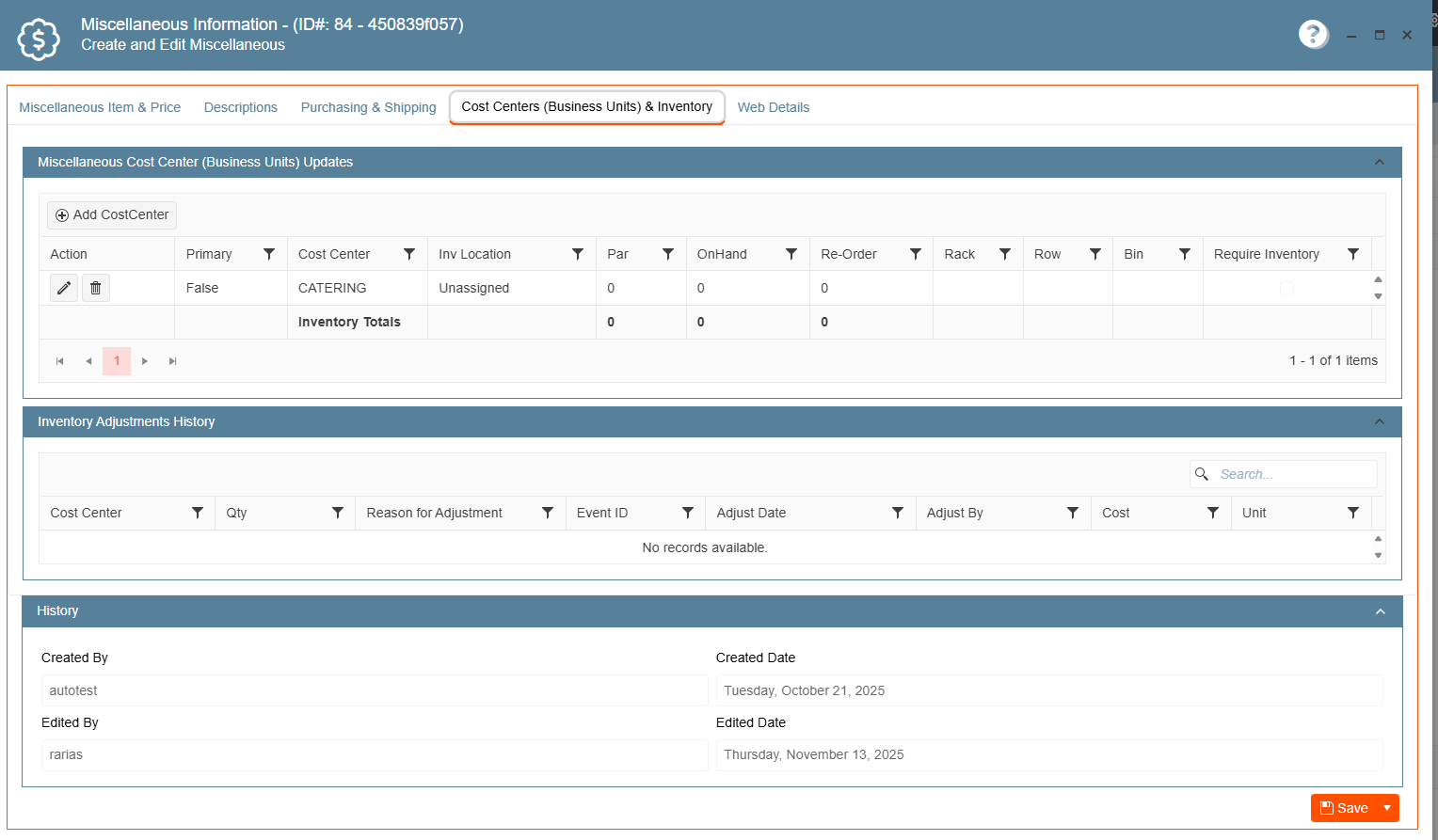
Section: Miscellaneous Cost Center (Business Units) Updates
Click + Add CostCenter to assign this item to one or more business units. Each row contains:
| Column | Description |
|---|---|
| Primary | Marks this as the primary cost center (True/False) |
| Cost Center | The business unit this item is assigned to (e.g., CATERING) |
| Inv Location | Inventory storage location within that cost center (e.g., Unassigned) |
| Par | Minimum quantity that should always be on hand |
| OnHand | Current inventory quantity at this location |
| Re-Order | The quantity threshold that triggers a reorder alert |
| Rack | Storage rack identifier |
| Row | Storage row identifier |
| Bin | Storage bin identifier |
| Require Inventory | Toggle — when ON, inventory tracking is enforced for this item at this cost center |
Inventory Totals row at the bottom summarizes Par, OnHand, and Re-Order quantities across all assigned cost centers.
Section: Inventory Adjustments History (read-only)
Grid showing every manual inventory adjustment made to this item:
| Column | Description |
|---|---|
| Cost Center | Where the adjustment occurred |
| Qty | Quantity adjusted (positive = added, negative = removed) |
| Reason for Adjustment | Why the adjustment was made |
| Event ID | Event linked to the adjustment, if applicable |
| Adjust Date | Date of the adjustment |
| Adjust By | User who made the adjustment |
| Cost | Cost value of the adjustment |
| Unit | Unit of measure used |
Tab 5: Web Details
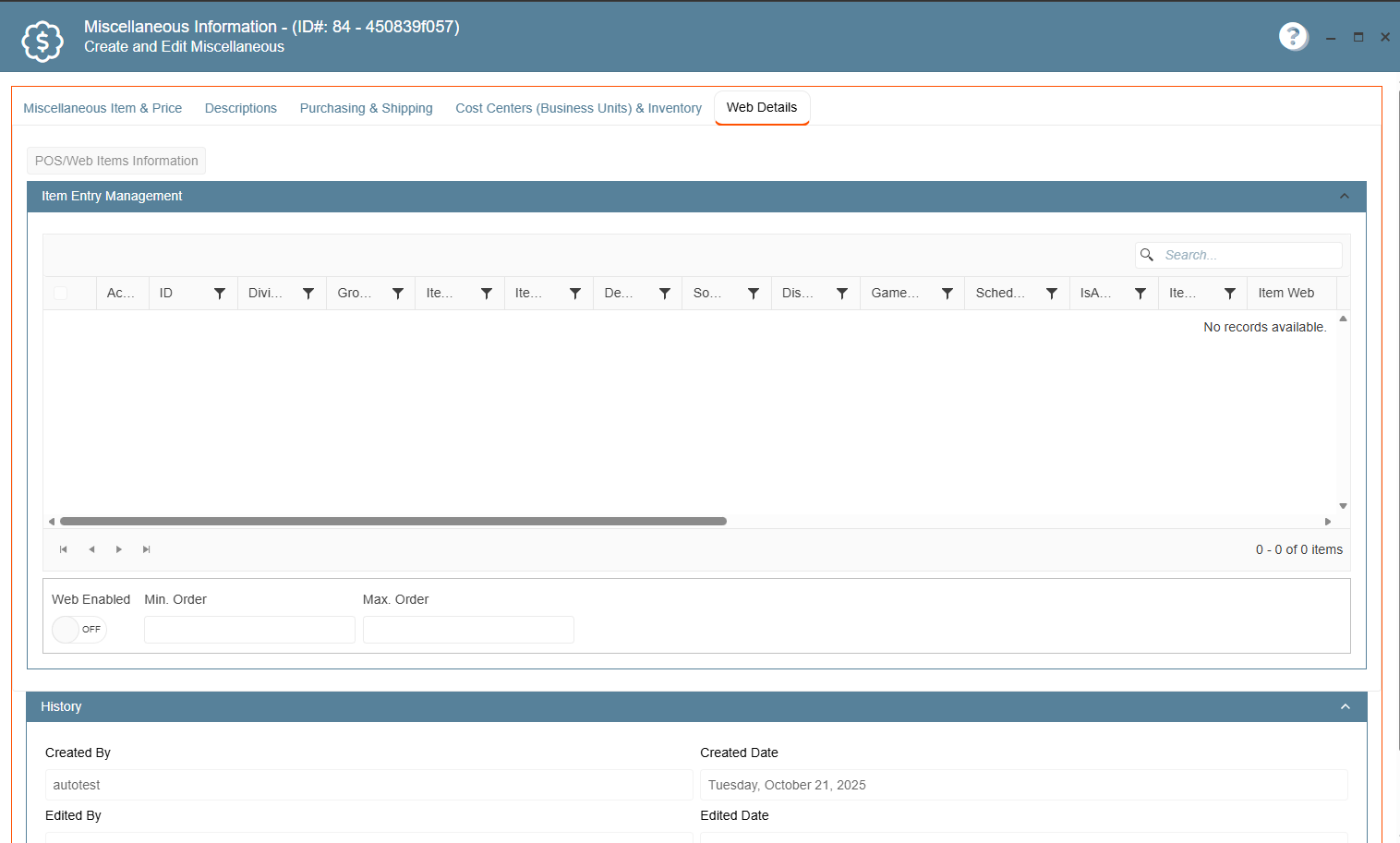
Controls how this item appears and behaves on the Elecate web portal.
Sub-tab: POS/Web Items Information
Item Entry Management grid — lists all POS/web configurations for this item. Columns: Action, ID, Division, Group, Item Name, Item Code, Description, Sort, Display, Game, Schedule, IsActive, Item Web.
Web Order Settings
| Field | Description |
|---|---|
| Web Enabled | Toggle ON to make this item available for ordering through the web portal. Default: OFF. |
| Min. Order | Minimum quantity a client can order through the web. |
| Max. Order | Maximum quantity a client can order through the web. |
Note: Web Details for Miscellaneous items does not include Order Size or Order Size Group fields (simpler than Beverage). Enable Web Enabled only if clients use the online portal to build event orders.
- Click on Save.
Quick Operations Summary
To add a miscellaneous item:
- Go to Data Items on the left side panel.
- Click Miscellaneous Items.
- Click Miscellaneous Item Management (All Items).
- Click New Entry.
- Fill out the information.
- Click on Save.
To edit a miscellaneous item:
- Go to Data Items on the left side panel.
- Click Miscellaneous Items.
- Click Miscellaneous Item Management (All Items).
- Click the pencil icon on the Action column.
- Edit the desired information, once finished click on Save.